.png)


Autism: When Driving is Not on a Parent's Radar...Until It Is


When your child is first diagnosed with autism, your mind doesn’t go to driving.
It goes to therapies. To milestones. To questions you didn’t even know existed yet. You start learning a new language as you enter a world full of IEPs, services, and advocacy. You focus on the now, because the now feels big enough.
Driving? That feels like a lifetime away....Until one day, it isn’t.
In a recent episode of our podcast Strength Happens, Janine and I interviewed Caryn Readdy and her son Dalton. For Caryn, that moment to consider driving came when her son Dalton, now an adult who is also diagnosed with Autism, started wanting more independence. He had built a life for himself. He worked at Publix, where he loved connecting with customers and took real pride in what he did. He's involved in sports through Special Olympics, he is part of his community, and like so many young adults, he wanted to drive himself to work.

And here’s what struck us most about her story, Caryn wasn’t worried about Dalton, she was worried about everyone else.
“I was more worried about the other drivers than Dalton… He’s a very good driver, very cautious.”
That line stopped us. Because it captures something so many of us feel but don’t always say out loud. It’s not just about whether our kids can do something. It’s about how the world will respond to them when they do.
Caryn’s mind went to the moments none of us want to imagine, but all of us quietly consider.
What if there’s an accident?
What if Dalton is overwhelmed?
What if he struggles to communicate in a high-stress situation?
What if law enforcement misunderstand him?
So she did what we all do, she started looking for a solution. She reached out to the DMV, assuming there had to be something simple already in place. Some way to indicate, quietly and respectfully, that a driver has a developmental disability. Something that could help in those critical moments.

There wasn’t. The only option was an ID card and that didn’t solve the problem.
“If he got pulled over… at least law enforcement would know right away… but they couldn’t just add it (to a license). It has to be a bill.”
And just like that, what should have been simple became something much bigger. But if there’s one thing we know about parents in this community, it’s this: we don’t walk away from the things that matter.
Caryn started writing. She created a proposal. She reached out to organizations, to representatives, to anyone she thought might listen. And for a long time…no one really did. Two years of trying to be heard. Two years of emails, redirections, and closed doors. It would have been so easy to stop there ... to decide it was too complicated, too big, too far outside of what one person could change.
But she didn’t.
Eventually, she reached out to someone a little outside the expected path, a local sheriff she had seen in the community, someone she felt might actually listen. And he did. That one conversation changed everything.
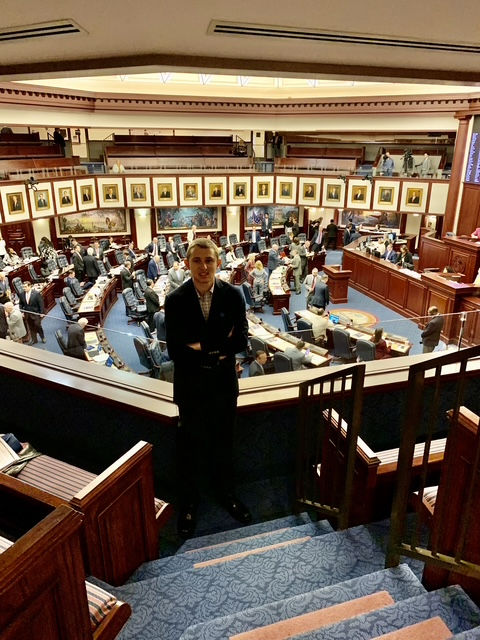
From there, the idea gained traction. A representative took it on. The process began. And over the next two years, Caryn, Dalton and her family stayed the course...driving to meetings, following the process, showing up again and again until finally, the bill was signed. Four years after the idea first took shape, change happened.
Now, in the state of Florida, drivers can choose to add a developmental disability designation to their license, a simple “D” that can quietly communicate something incredibly important in the moments that matter most. It’s voluntary. It’s discreet.
And it offers something so many of us are always searching for: Peace of mind.
Not because it solves everything but because it creates understanding where there might otherwise be confusion. And maybe that’s what makes this story linger...It’s not just about a license.

It’s about what happens when a parent looks at a gap in the system and says, this matters.
It’s about the kind of persistence that’s born not out of ambition, but out of love.
It’s about the reality that so many of us are thinking about things we never expected to think about: driving, independence, safety in the community and figuring them out as we go.
And it’s about the quiet, powerful truth that change often doesn’t start in a boardroom or a policy meeting. Sometimes, it starts with a mom asking a question no one else has asked yet and refusing to let it go.
Caryn encourages others, “If you have an idea… don’t give up. Just keep reaching out until you find someone willing to listen.”
We don’t always know, in those early days after diagnosis, where this road will lead.
But stories like this remind us sometimes, it leads to places we never imagined.
And sometimes…it leads to change that helps not just our child, but an entire community.
That’s the kind of strength we’re talking about when we say: Strength Happens.

Here more about Caryn and Dalton's story on our podcast Strength Happens. Check out Season 2: Episode 8: Real Autism Stories of Autism: Raising a Son with Autism and Changing Florida Law Because Of It.
Resources
----------------------------------------------------------


Comments